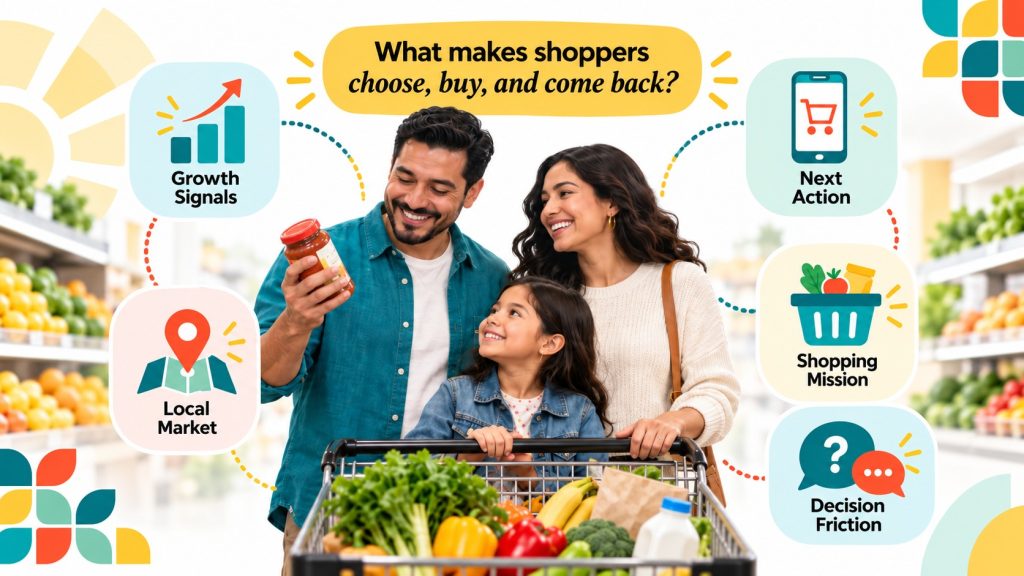
Hispanic households continue to contribute to U.S. retail and CPG growth, but shoppers are also becoming more selective about what earns a place in the cart. For CPG leaders, that changes the question. It is no longer enough to ask, “Are we reaching Hispanic consumers?” A better question is: What is making this shopper choose, buy, and come back?
Here are five Hispanic shopper insights worth putting into your 2026 retail plan.
1. Hispanic Retail Growth Does Not Always Mean Stronger Household Performance
A brand can increase sales because it reached more households while repeat purchase declined. Dollar sales can rise while unit movement stays flat, and sampling can generate trial without generating another purchase. Those are different growth stories, and they require different responses.

When evaluating Hispanic retail growth, look at household penetration, purchase frequency, units, repeat behavior, and sales together. This gives brand teams a better view of what is driving performance and helps them build a stronger business case for Hispanic retail growth when leadership asks what the investment accomplished.
A useful question to bring into your next review is: Are more Hispanic shoppers entering the brand, or are existing shoppers choosing it more often? If you cannot answer that, you have found your first measurement gap.
2. The Store Still Matters, but the Relationship Should Continue After It
Hispanic consumers continue to show a strong connection to physical retail. Circana reports that they are generally more likely to shop in stores than online. At the same time, digital shopping and mobile behavior play a growing role in how shoppers discover and evaluate products. That makes the store and the phone complementary parts of the same shopper experience.
An in store product experience can lead shoppers to a recipe, offer, product education, survey, store locator, or useful content. But the technology itself is not the strategy. A QR code is not a KPI. The behavior it creates is.
Instead of counting scans alone, measure what happens next. Did shoppers save an offer, provide feedback, explore another product, or return later? Before adding a digital element to a retail activation, ask one simple question: What do we want the shopper to do after this interaction?. The bigger opportunity is to connect trial to purchase and repeat behavior, rather than treating each interaction as a separate campaign
3. Understand the Shopping Mission, Not Just the Demographic
Hispanic households tend to be larger than the U.S. average, which can affect how shoppers evaluate:

- Quantity
- Versatility
- Value
- Household acceptance
But household size tells only part of the story. Someone preparing weekday dinners has different priorities from a shopper stocking up for two weeks, and a parent shopping for school lunches evaluates a product differently from someone planning a family gathering.
This is why retail briefs should define the shopping mission, not just age, ethnicity, and language. Ask what the shopper is trying to accomplish, who will use the product, what could replace it, and what information could remove hesitation.
Sometimes the conversion question is not, “Do I like this?” It is “Will we use this at home?” That question can change the message, pack size, recipe, product education, promotion, or cross merchandising strategy.
4. The ZIP Code Can Tell You More Than the Word “Hispanic”
Hispanic shoppers do not represent one culture, one language preference, or one shopping pattern. Country of origin, generation, geography, household composition, retailer preference, and product familiarity can all affect behavior. A Southern California store may serve a different shopper mix than a store in Miami, New York, Phoenix, or Houston. Even two stores within the same city may behave differently.
Before repeating the same retail execution across markets, examine the retailer, trade area, local community, language preferences, product familiarity, and shopper needs. We explored why local market context matters in Hispanic marketing in our recent Hispanic Heritage Month article. The closer the strategy gets to the store, the more specific the planning should become.
This distinction also helps reduce a common cultural mistake. Translation answers, “What language should we use?” Shopper strategy answers, “Why should this person care?” Spanish may improve access, but cultural context gives the message meaning.
5. Shopper Hesitation Can Be More Valuable Than Another Impression
Retail reporting often focuses on what happened, including interactions, samples, scans, and units sold. The harder and often more useful question is why. A shopper who asks how to prepare the product, compares its price, questions an ingredient, mentions another brand, or says the package is too large is giving you information.
We can think of these moments as decision friction, the questions or concerns standing between interest and purchase. Field teams can capture repeated questions, objections, intended uses, price reactions, competing brands, and reasons for purchase. When those observations are compared with sales, surveys, digital activity, and retailer feedback, brands gain shopper intelligence they can use in future planning.
Maybe shoppers know the product but do not understand how to use it. Maybe trial is strong, but repeat use is unclear. Maybe one message consistently moves shoppers from hesitation to purchase. These findings can inform packaging, retailer presentations, product education, marketing content, and future retail programs.
Pressure Test Your 2026 Hispanic Retail Plan
Before your next Hispanic shopper marketing program launches, ask whether you know what is driving growth, whether the shopper has a useful next action after the retail interaction, whether you understand the shopping mission, whether the plan reflects the local market, and whether you are learning why shoppers buy or walk away.
If several of those answers are unclear, the issue may not be your media budget or creative. You may be missing the shopper signals that should shape both.
Put These Hispanic Shopper Insights to Work
NeoSol’s Hispanic Retail Growth Playbook gives CPG marketing teams a practical framework for Hispanic market segmentation, local retail planning, cultural context, consumer engagement, and measurement. Download the Hispanic Retail Growth Playbook here.
Already have a Hispanic retail plan? Use these five questions before your next retailer meeting, agency brief, or budget conversation. If you want another perspective, request a Hispanic Retail Growth Strategy Session to review your current program and identify which shopper signals deserve more attention.
The brands that grow with Hispanic shoppers will not be the ones saying the most about Hispanic consumers. They will be the ones learning the most from them.
Which of these five shopper signals is your current retail strategy actually measuring?
→ Request a Hispanic Strategy Session
For more knowledge and insights subscribe to our newsletter HERE.