Most brands approach Hispanic retail growth quarter by quarter.

A sampling program here.
An influencer burst there.
A seasonal activation tied to cultural moments.
Each initiative may perform well, but growth built in fragments rarely compounds.
When brands ask how to scale across regions, especially in competitive categories like hydration or expanding traditional Hispanic beverage brands, the conversation must shift from campaigns to structure.
The question is no longer: “How many activations should we run?”
It becomes: “What does a 12-month Hispanic retail growth roadmap actually look like?”
Why Campaign Thinking Limits Scale
Campaigns are designed to generate momentum. Roadmaps are designed to build systems.
Retail buyers do not evaluate growth based on one successful weekend. They evaluate sustained velocity, repeat purchase patterns, and regional scalability.
For culturally rooted beverage brands expanding into new markets, heritage may drive trial, but infrastructure drives repeat purchase across banners and regions.
Without a structured plan, brands often remain in permanent pilot mode. They test, they activate, they adjust.
But they rarely scale predictably.
A roadmap changes that because every activation contributes to a larger system.
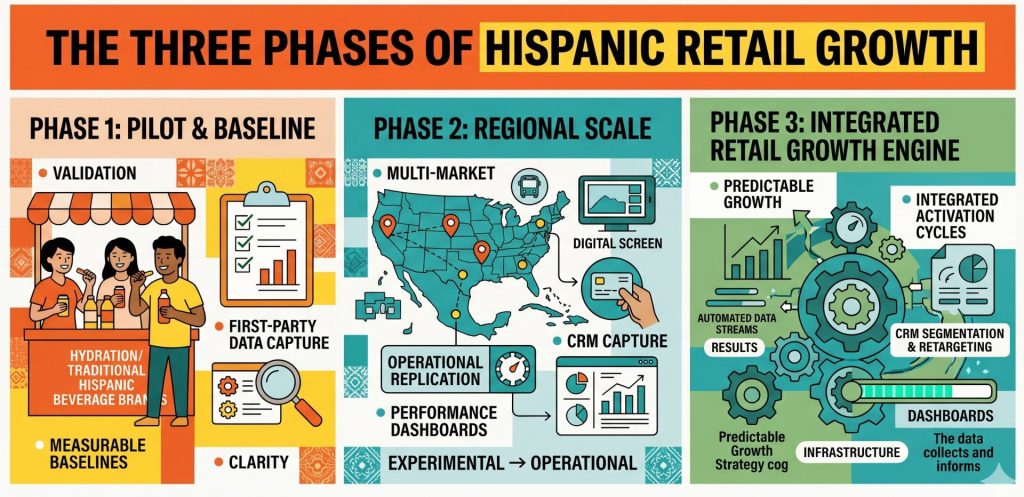
Phase 1: Pilot & Baseline (Months 1–3)
The purpose of a pilot is not volume. It is validation.
This phase establishes the operational and measurement foundation required for scale.
Strong pilot programs focus on:
• Retail activation cadence
• First-party data capture standards
• Baseline lift measurement
• Initial repeat behavior tracking
• Operational discipline in reporting
For hydration brands, this means validating how sampling converts to measurable shelf velocity.
For traditional Hispanic beverage brands, it means testing how cultural affinity translates into repeat purchase behavior in specific corridors.
The outcome of Phase 1 should be clarity.

- What lifted?
- Which retailers outperformed?
- Where did repeat behavior emerge?
- Which regions show expansion potential?
Without measurable baselines, expansion decisions become assumptions.
Phase 2: Regional Scale (Months 4–8)
Once lift patterns are identified, scale becomes structured.
This phase focuses on operational replication across multiple markets while maintaining measurement consistency.
Key priorities include:
• Multi-market activation waves
• Consistent CRM capture across regions
• Digital reinforcement tied to retail presence
• Performance dashboards tracking regional velocity
• Optimization cycles based on real data
This is where brands often hesitate. Scaling feels risky. But risk decreases when Phase 1 produces validated performance patterns.
In hydration categories, this phase often reveals which retail corridors outperform and which activation cadence drives repeat purchase most efficiently.
For heritage beverage brands, regional scale tests how cultural equity travels beyond legacy markets.
At this stage, Hispanic retail growth stops being experimental. It becomes operational.
Phase 3: Integrated Retail Growth Engine (Months 9–12)
The final phase transforms activity into infrastructure.
At this stage, brands operate with:
• 6-12 month integrated activation cycles
• Ongoing CRM segmentation and retargeting
• Executive-ready reporting dashboards
• Quarterly strategic reviews
• Retailer-level expansion planning
This is where Hispanic retail growth becomes predictable. Activation is no longer episodic. It is embedded into the broader growth strategy.
Data is no longer collected occasionally. It informs every decision.
Budgets become easier to defend internally because performance trends are visible over time.
That matters for overstretched brand teams managing multiple priorities and needing stronger justification for multicultural investment.
………………
The Hidden Cost of Staying in Pilot Mode
Many brands never move past Phase 1, not because pilots fail, but because structure isn’t defined in advance.
Without a roadmap, pilots become isolated projects, and isolated projects rarely scale.
A defined 12-month roadmap does not guarantee growth, but it dramatically increases the probability of compounding lift across regions.
How to Know Where You Are Today
If you’re evaluating your Hispanic retail strategy, consider three questions:
- Do we have baseline lift data tied to specific retail corridors?
- Are we capturing first-party data consistently at activation?
- Can we confidently outline what expansion looks like over the next 6–12 months?
If the third answer feels unclear, the opportunity may not be more campaigns. It may be more structured.
Growth Favors Structure
Hispanic retail growth is no longer about visibility alone. The brands gaining market share are building integrated systems across retail, digital, and community engagement.

- Retail activation.
- Data continuity.
- Regional optimization.
- Executive alignment.
A 12-month roadmap does not limit flexibility. It provides direction, and direction is what transforms multicultural marketing from a series of campaigns into a scalable growth engine.
If you’re exploring how to move from pilot to structured expansion, the conversation usually starts with one question:
- Where are you today, and what would it take to scale responsibly? That’s where roadmap thinking begins.
Looking at Hispanic market expansion over the next 6 to 12 months?
Start by evaluating how your retail activations, regional performance, and consumer engagement systems are working together today. Small operational improvements often create the biggest long-term lift.
Book a strategy session with us today and we can help you review current initiatives, identify operational gaps, and outline what scalable Hispanic retail growth could look like across regions, retailers, and consumer touchpoints.
→ Request a Hispanic Strategy Session
For more knowledge and insights subscribe to our newsletter HERE.